
GuideWhich heat pump for my pool?
In 3 steps: calculate the water volume, choose your swimming season, then find the model. With a ready-to-use table for the most common sizes.
How many BTUs for my pool?
1. Calculate the water volume
Round pool: 3.14 × radius² × average depth (in metres) × 1,000 = litres. Example: a 24 ft above-ground pool (7.32 m in diameter) with 1.2 m of water holds about 51,000 litres.
Rectangular pool: length × width × average depth (in metres) × 1,000 = litres. Example: a 16 × 32 ft inground pool (4.88 × 9.75 m) with an average depth of 1.5 m holds about 71,000 litres.
2. Choose your swimming season
Our rule of thumb: about 1.3 BTU per litre to swim from June to August, and 1.5 BTU per litre to extend the season from May to September.
3. Find the model
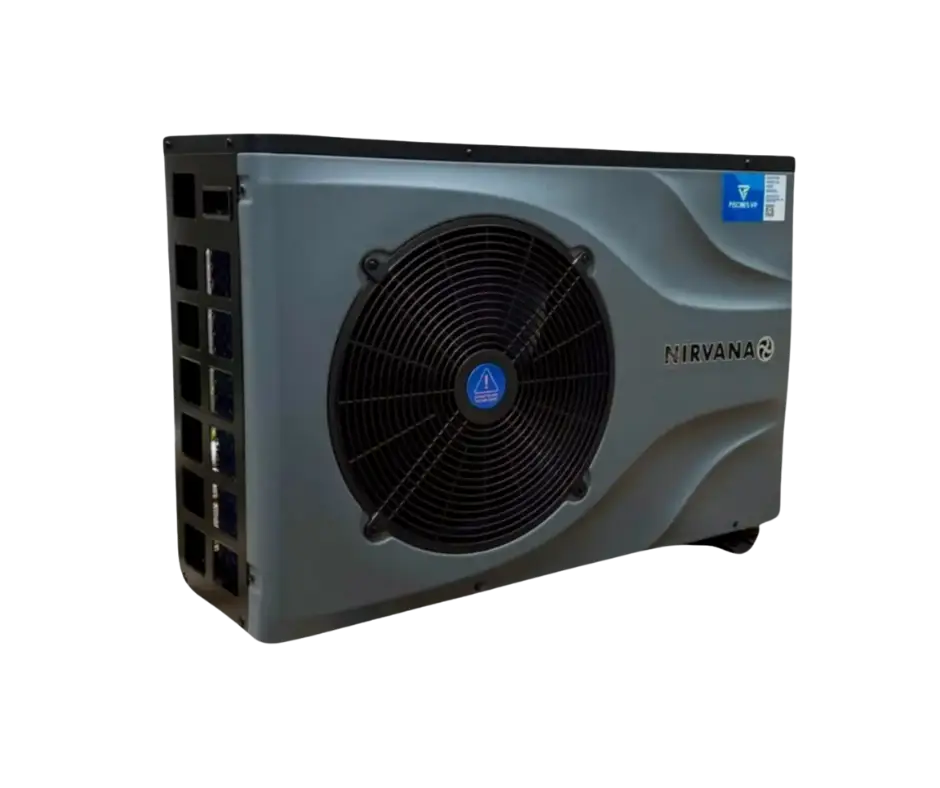
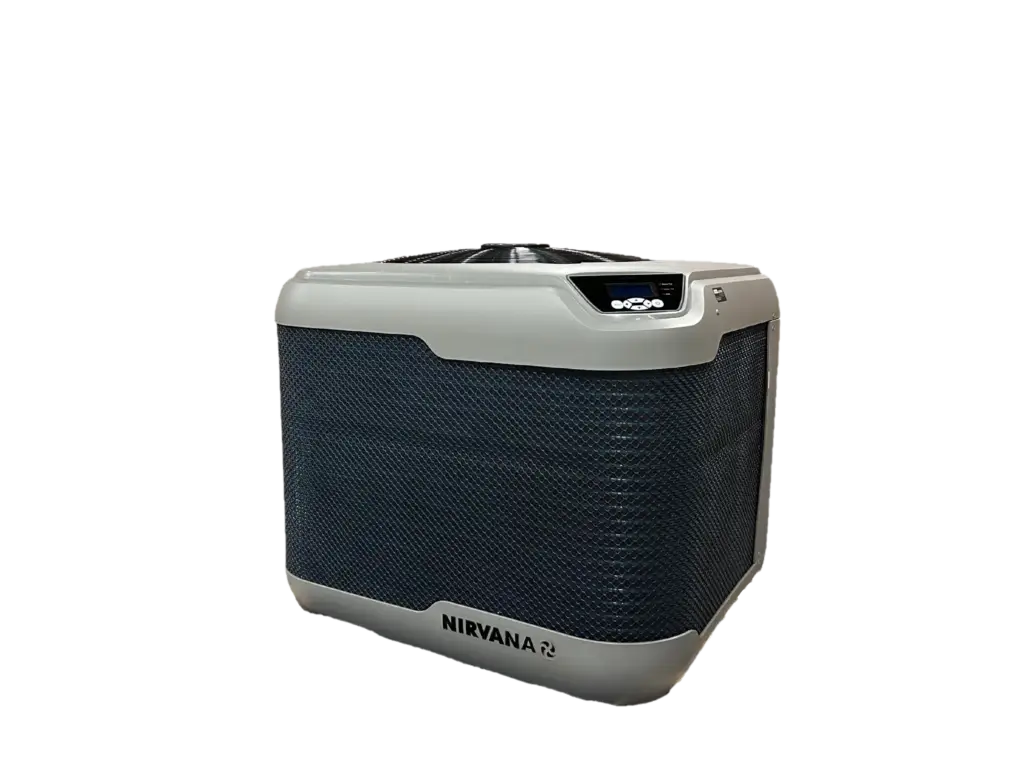
Take the smallest model whose output (at 80/80/80) exceeds the result. Example: 51,000 L × 1.3 = about 67,000 BTU, so a Nirvana NE80 or an FC 75.
It's an approximation, not an exact science. Wind, shade, the actual depth and a solar cover change the need. A technician always confirms before the quote.
The table, size by size
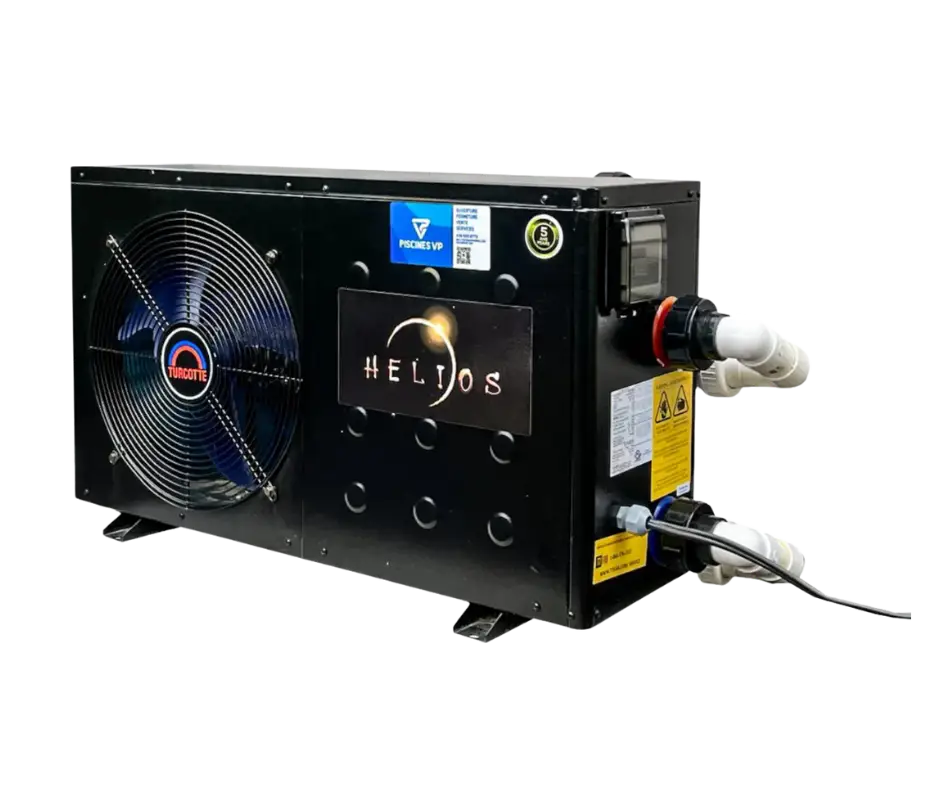
| Pool | Approx. volume | June to August (1.3 BTU/L) | May to Sept. (1.5 BTU/L) | Nirvana NE | Nirvana FC | Nirvana PV | Helios |
|---|---|---|---|---|---|---|---|
| Above-ground 15 ft | 20 000 L | 26,000 BTU | 30,000 BTU | NE50 | FC 60 | PV 85 | Helios 50 |
| Above-ground 18 ft | 29 000 L | 37,000 BTU | 43,000 BTU | NE50 | FC 60 | PV 85 | Helios 50 |
| Above-ground 21 ft | 39 000 L | 51,000 BTU | 59,000 BTU | NE60 | FC 60 | PV 85 | Helios 120 |
| Above-ground 24 ft | 51 000 L | 67,000 BTU | 77,000 BTU | NE80 | FC 75 | PV 85 | Helios 120 |
| Above-ground 27 ft | 65 000 L | 84,000 BTU | 97,000 BTU | NE100 | FC 105 | PV 110 | Helios 120 |
| Above-ground 30 ft | 80 000 L | 104,000 BTU | 120,000 BTU | — | FC 125 | PV 110 | Helios 120 |
| Inground 12 × 24 | 40 000 L | 52,000 BTU | 60,000 BTU | NE60 | FC 60 | PV 85 | Helios 120 |
| Inground 14 × 28 | 55 000 L | 71,000 BTU | 82,000 BTU | NE80 | FC 75 | PV 85 | Helios 120 |
| Inground 16 × 32 | 71 000 L | 93,000 BTU | 107,000 BTU | NE100 | FC 105 | PV 110 | Helios 120 |
| Inground 18 × 36 | 90 000 L | 117,000 BTU | 135,000 BTU | — | FC 125 | PVT 175 | Helios 120 |
| Inground 20 × 40 | 112 000 L | 145,000 BTU | 167,000 BTU | — | FC 150 | PVT 175 | — |
It's an approximation, not an exact science: wind, shade and a solar cover change the need. A technician always confirms before the quote.
80/80/80 or 50/63/80?
Manufacturers publish output based on test conditions: air temperature, humidity and water temperature, in °F.
- 80/80/80: a hot summer day. It's the value shown most often.
- 50/63/80: a cool evening in May or September. The output is lower, but it's more realistic for extending the season in Quebec.
Always compare two heat pumps under the same conditions, and prefer an AHRI-certified output: it is verified by an independent organization.
What changes the calculation
Solar cover
At night, a cover keeps the heat in the water. Without a cover, plan for more output.
Exposure
A pool exposed to the wind loses its heat faster.
Sunlight
A shady yard gets less benefit from the sun: the heat pump works harder.
Frequently asked questions
Is an oversized heat pump a problem?
It will heat faster, but it will cost more to buy and require a bigger breaker. The right model is the smallest one that covers your need.
What if my heat pump is too small?
It will heat slowly and have trouble keeping the water warm in spring and in September. When in doubt, we suggest the next model up.
How long does it take to heat my pool?
It depends on the output, the volume, the air temperature and the solar cover. Expect a few days in spring in many cases; after that, the heat pump maintains the temperature.
Can I use this calculation for a spa?
No, a spa is heated differently. Tell us about your setup.
We do the calculation with you
Give us your pool's size and your swimming season: we'll get back to you with the right model and a clear price.